Showing posts with label Guatemala. Show all posts

Monday, May 16, 2011

Guatever!

I'm going to try to keep this a brief as possible. It's a few days worth of writing, so I apologize for the abruptness in my stories/descriptions. Some of this is from an essay that I wrote about my trip, other parts aren't. If it seems like the writing styles are different and switching quickly, that is probably why. If you would like more information, feel free to comment, and I can fill in any blanks.

So the last time I left off on the blog for Guatemala, I was entering San Jorge La Laguna. We drove through the mountains and around volcanoes, and we stopped on an overlook. What a fantastic view of Lake Atitlan and San Jorge! I was already convinced that Guatemala was a beautiful country with people stuck in tragic circumstances. On the overlook, the native people were selling trinkets like I had seen in Antigua, hoping to tempt tourists into buying things they don't really need. Resisting the urge to buy everything from the cute little girls, we stepped back into our van and headed straight to San Jorge just below.

 Driving into San Jorge was a shock. I stared out the window at the little town on a steep hill and realized that I had signed up for a week of hard work and heartache. We passed houses, shacks, women in traditional outfits, children with worn down soccer balls, without shoes, with smiles, waving and yelling, stray lazy dogs laid in the middle of the streets to find the sun. The colorful outsides of the houses seemed to be hiding the dirt floors and rusted tin walls on the inside. We passed tiendas and children and women selling fruit on the street.

I was in a third world country—there was poverty and starvation and health problems. The old women looked ready to fall over with the weight of their heavy loads, and the men went by in the street waved to other men in greeting. The streets were dirt and rough cobblestone, impossible for climbing the steep hills and hard on the feet. The white and yellow church in the center on the town gleamed in the sunlight, a beacon to the world that San Jorge was still alive after hundreds of years.

Little guy, Alex! He was such a ham!
Young boys out of school for the day ran back and forth in the main dirt square, chasing a small ball that resembled a soccer ball and tried to score between posts—there were no nets for the goals. They laughed and ran to work off their built up energy, and when our group jumped out of the vans, they stared for a second, but continued playing with quick glances every so often thrown our way.

A man named Daniel welcomed us. He owns a travel company that arranges "authentic" homestays in San Jorge. He is a native to the small town, but works in the neighboring Panajachel, a larger tourist town. Our host mothers were there to greet us, and my roommate, Stephanie, and I were able to meet Anna. She is an older grandmother and lived in one of the wealthier families in town. She immediately started speaking Spanish. Stephanie is a Spanish major and was able to translate for me. Although I can easily translate Spanish, I can't speak it well. And I learned how much I had lost in the past two years. I could not communicate, but I followed most of their conversations. We walked through their game to get to the house we were staying in, and they giggled as they spoke in the native Mayan language, Katichiqel. The children pointed and in whispered voices said, “Gringos.” I'm not sure if it an insult to them; it may just be a statement of fact to them, and I wasn't offended, just curious.

Entering the house, I immediately regretted my suitcase. I felt like I was bragging. A family of a dozen or more lived in the small area, and here I packed a suitcase for a week of work. Stephanie had a bed to ourselves, not a mattress but thick woven straw and pads on top of them. It wasn't the most comfortable, but it was clean and generous. After a hard day of work, I didn't care all that much anyway. We went up to the school to visit our worksite almost immediately.

With over 600 children attending the school in the morning for their primary school, the school was out of room to place all of the students. The students and community had been gathering trash—plastic bottles and wrappers that wouldn’t degrade—and stuffing bottles with small bits of waste to make them sturdy. Once the bottles were stuffed, they were to be used as “eco-bricks” and put inside wire underneath plaster for the walls of the schoolroom. Our group decided to help with their sustainability efforts.

After trudging our way up a hill, around corners, through uneven streets, avoiding stray dogs, passing by small, shy children in doorways, we came to the school. A small building with no more than ten rooms, and a “playground” that consisted of a rusted and warped slide and rough monkey bars that sat outside dingy and dirty bathrooms. The kids played with a small ball, kicking it back and forth, hitting windows, running down stairs, not caring that their plastic ball wasn’t really a soccer ball. We climbed around to the back of the school where the new room would be. Roots from trees stuck out of the ground, rocks blocked our path—there was no good way of getting around. A steep hill was our worksite. Two tall trees had to be cut for the room and pine needles and woodchips from the bark littered the ground.

Danielito, Daniel's little boy.
My mouth dropped. Our eyes displayed our disbelief. Digging in this area was going to be more difficult than we had planned. I had just wanted a spring break that would help others while also getting me out of the country. This was actual work. The mayor and contractor were at the bottom of the hill, beaming at our presence. They had been expecting us for a long time, and now that they had the free labor, they could start their much needed schoolroom. Daniel, our English translator and never without a smile, told us that the people were so happy we were there. The mayor, in his traditional Mayan dress, nodded his head even though he didn’t speak English. Daniel stood to the side and grinned widely and laughed. I wasn’t sure why, but the men were speaking in Katichiqel, making me believe that one of them had said something about us—probably something to do with the scared looks on our faces. “Alright,” Daniel clapped and rubbed his hands together with an enthusiastic look, “Let’s get started.”

For the next four days, we worked like crazy. We never reached our goal of completing the room, and suffered a setback when our trenches caved in on the second day for the foundation. We passed stones, made cement by hand (hard work!), dug a lot of trenches, and sat around waiting. We mostly tried to stay out of their way until they needed us to pass cement or rocks or bricks. I did enjoy pick-axing though. That was a ton of fun!

Some of the group digging the trenches.
 After three days of hard work, the dirt and grime were starting to seep into my pores; I was more than ready for a break. At lunchtime, we began our decent into the town to Daniel’s house where lunch was waiting for us. My stomach grumbled when I smelled the mouthwatering chicken cooking from inside the small kitchen. We were tired. Little conversation, but a lot of eating. We had our fill, but Daniel’s wife insisted they had plenty more if we wanted it. Brushing off her attempts graciously, the group headed outside. I sat on the church steps and watched the young children play on their makeshift soccer field. They laughed loudly when some of our group joined their game, calling some of them loco or feo—crazy and ugly.

While they played, the rest of the group waited for Sharon, a woman from Mayan Families, an organization established to help families in San Jorge and other small towns like it. Sharon rounded the corner and greeted us with an Australian accent, “Hi all. I hope I wasn’t keeping you waiting long. Why don’t we run up to the school quick to talk about our program, yeah?”

She smiled, but it never reached her eyes. She looked exhausted. We followed her as she weaved in and out of streets towards the preschool. We walked in and twenty enthusiastic “holas” reached our ears. Young children sat at tiny desks in a brightly colored room eating a snack of mango and watermelon. Sharon started speaking in Spanish to the children, and then turned to us, “This is a preschool for hand-picked children that were not getting enough nourishment at home. They all come and receive a vitamin supplement and two meals. They also get a head start on learning Spanish, so they may not understand you at times.”

Some children that visited near our worksite.
We waved, and the children laughed and blushed at the small gesture. Sharon said something to them that made them giggle louder. Their smiles were infectious, and I grinned just as widely as I watched two boys chase each other around the colored room. A girl a bit older than the rest of the children walked up to Sharon and hugged her. Sharon explained that her name is Claudia, “She is a young girl that lost both of her parents at a very young age. She lives with her grandmother who is too old to work, so Claudia couldn’t afford to go to school,” Sharon sighed and stroked the girl’s hair.

“We were able to sponsor Claudia to go to school. We sponsor 300 children in San Jorge alone, thanks to generous sponsors and donators,” Sharon smiled and gave Claudia another hug and sent her on her way. I watched as Claudia walked away—her shoes were worn and her clothes hung loose, but her smile brought our attention away from her poverty. She was happy to go to school, excited at the chance to learn. She picked up a backpack at the door, turned and waved at the door, disappearing down the street.

“Well,” Sharon started, “Shall we continue to our elderly lunch program?”

We followed Sharon out the door, and the children waved as we went, thanking us for coming and laughing as they did so. We wound our way back through the streets, only to find ourselves exactly where we started. Continuing our trip, we walked just by Daniel’s house and entered a green framed door, the paint chipped by the weather and age. A dozen older women sat eating lunch. “This is our elderly lunch program. Five days a week we provide lunch to elderly woman that cannot get lunch on their own,” Sharon patted a woman on the shoulder and gave her a small squeeze. Many stood precariously as we entered. A woman with a wrinkled face and hunched back took my hand gently and kissed it, saying “Gracias” quietly. Her hands were rough with wrinkles, but smooth from years of use—worn down by hard work and stress. Tears welled in my eyes as she pulled me into a gentle hug. They smiled and waved as we exited the door.

We were exhausted and happy to be moving in to a hotel with hot showers and comfortable beds in neighboring town down the mountain, Panajachel. Our homestays were over after two days, and the last two days of work were spent in the hotel. The group piled into the back of old Ford pickup trucks, fixed with 2x4 handles at head-level. I gripped the handle tightly knowing we were going to stand the entire drive (video at the bottom). The bumpy, dirt road made me nervous; I had always been taught to wear a seatbelt and now I was riding like the locals—necessity over safety. The gorgeous views of Lake Atitlan and the volcanoes surrounding the lake distracted my thoughts. The sun was setting—a light orange mixed with the clouds that lightly embraced the volcanoes. The water danced with the vanishing sunlight, shimmering with life. The truck took a hair-pin turn too quickly, jolting me back to the dangerous situation. We slowed as we entered Panajachel. People filled the streets along with restaurants, bars, and traditional markets. Horns blared when tourists walked too far into the street, and the open-sided local taxis—tuk tuks—buzzed in between people, narrowly dodging fatal accidents.

The town of just 15,000 people was alive, moving, busy with excitement. The energy was contagious, and I was anxious to explore the new city. After making our way down the tourist street, the trucks stopped abruptly. Wanting to stretch and explore, I jumped out of the back and continued down the street in the direction of the lake. The shopkeepers shouted, asking me to step into their store, “Adalante!” I smiled, shook my head, gave a curt “No gracias,” and kept walking. When I reached the water’s edge, I gasped at the change in scenery. The sky was a deep purple, fading into a light blue that mixed with the softly moving lake, making it difficult to distinguish the line between sky and water.

Leaning on the stone that separated tourists from the edge, I watched the volcanoes greedily cover up the sun as it dropped steadily into the earth. A young girl with a sad face tapped my arm and held up a bundle of homemade string bracelets. I shook my head. I didn’t want any. She was persistent and asked me to look at the bunch. I looked down at her. I couldn’t resist her innocent face—a ploy her parents used to catch sympathetic tourists. Young girls selling trinkets and candies on the streets were not uncommon. Many were not able to come home until they made enough money to bring to their families. “Cuanto cuesta?” I asked, wanting to know the cost.

She replied sadly, “Cinco Quetzales.”

Five Quetzales was too much to pay for a single bracelet in Guatemala; most of the goods that we bought were so cheap we were often excited at the prospect of spending less money for more product—typical Americans. But those five Quetzales translated to less than one American dollar; it wasn’t worth bargaining—she needed the money more than I did.

The young girl’s face was haunting. She held two bundles of bracelets in her hands; she handed me one. She watched me carefully as I picked out my bracelet, going for colors that would remind me of the sunset—blue, purple, orange, yellow. Her large eyes stared into mine—blank and almost hopeless. My heart wrenched at the sight, and I started to tear up at her expression. Her head rested on her extended arm on the wall, the light blue sky and volcanoes framed her face. The beautiful landscape gave way to the little girl with the round face and brown eyes—she was Guatemala; dark, beautiful, tragic, poor, lonely, starving. If she had been in the United States, she could be going to school, playing with other children. She wouldn’t have been barefoot. She wouldn’t have had to work to make sure her family survived. Her face turned to look up at me quickly and then back down at the unclaimed bracelets in my hand. I smiled and thanked her as I handed her the money owed. I wished I could have done more—I could have. I could have bought more bracelets, given her more money. But I didn’t.
The little girl with the bracelets.
I watched as she lethargically gave her grandmother the money she earned; she received no praise, just more bracelets and trinkets to sell to tourists. I tied the bracelet around my wrist and held it up to the skyline. I knew the colors matched perfectly, but I couldn’t see the colors. I only saw the young girl’s sad eyes.

Me on the boat ride, trying not to get wet!
 That night and the rest of the nights, we shopped and ate in Panajachel. It was a lot of fun, and I enjoyed the ride there and back the two days. On our last day in Panajachel, we had a tour across the lake. It was a good hour boat ride across the lake. We visited two towns on the lake and learned how they make the goods as well as dye the clothe used for clothes. It was a warm day filled with a lot of walking and bumpy boat rides. I finished up my tourist shopping that day, bought some coffee (I hear it was delicious), little trinkets, and got a little sunburned. I started feeling a little queasy on the boat trip back, but it was okay in the end. We left Panajachel in the afternoon and went back to Guatemala City for our flight the next morning.

The three hour drive was uneventful; it rained most of the way back, and I slept almost the entire time to avoid motion sickness. We drove into the city to a very nice hotel close to the airport at about 8 p.m. We decided we needed to eat, so we walked to a nice restaurant close by. We passed the US Embassy, and that is my first encounter with an Embassy. It looked more like a prison; the high walls, cameras, guards, and signs that said "No pictures" were intimidating. The restaurant was a steak place, and we had a lot of extra money, so I didn't mind spending a little more than usual. I ordered and chowed down on the delicious meal.
 
I went to bed quickly after packing; I wasn't feeling well about two hours after getting back from dinner. I checked my email for the first time since getting there, and passed out in bed. I woke up at about 2:30 in the morning, feeling like I was going to throw up. I really didn't want to but, it couldn't be avoided. I ended up throwing up multiple times as well as having diarrhea. I was miserable, and I was getting on a plane in less than ten hours. Stephanie was extremely helpful, getting my pills and water as well as helping me camp out in the bathroom. I learned in the morning that two other people were violently sick as well, and they had the exact same thing to eat. After being up until 5 a.m., I was tired, and my stomach was still not settled, but calm enough to know I wasn't going to throw up again.
 
As soon as we arrived at the airport, we were told our connecting flight was delayed by a few hours, meaning we wouldn't get into Chicago until after midnight. I was pat down multiple times in Guatemala and El Salvador (our connecting flight location). So, we camped out in San Salvador for a few hours. It wasn't enjoyable, but by that time, I wasn't really caring. I still had the urge to throw up and was suffering from diarrhea. I ate just the bread from Subway and played cards. The flight to Chicago was bumpy, and a lot of our group was throwing up in the baggies on the plane. I tried hard to block it all out, and made it off the plane without throwing up! We booked a hotel in Chicago once we heard of our delay, making us miss another day of classes.
 
I was so happy to be back in Pella. I enjoyed my trip, but the last 36 hours of it made me miserable. I was sick for more than a week once I got back. Looking back, I really enjoyed my experience. Next time though I will be more careful about my food!
 
I cut that short because this was getting long! Here is the video I promised (it's a bit shaky...I was in the back of a pick-up):

Wednesday, April 20, 2011

Guat's up?

Our suitcases on top of the van!
This is already much later than I promised, so I apologize. School has a funny way of just demanding all of my attention, and even then, I still struggle to get everything done. But, as promised, here is one of my blogs dedicated to my time in Guatemala. I hope to have the other one up soon, but as seen in my last blog promise, it may not happen. I have every intent on trying though!

My fellow ASBers (the group of 12 students and two adults) and I left for Chicago on a Sunday night, planning on getting to Chicago at about midnight on Monday as our flight took off on Monday at 2 a.m. After a loooong drive to Chicago, we boarded our plane and arrived in Guatemala at about 6:30 a.m. We quickly grabbed our luggage, breezed through customs, and entered the country of Guatemala. As warned by our trip supervisor, Ali, we had to hold onto our suitcases tightly once we exited the airport because taxi drivers may try to take our bags and put them in their cabs. Nervous, I gripped the pull out handle and ventured out into the morning sun. It was gorgeous outside! It was almost 80 degrees and it wasn't even 7 a.m. yet! My worries vanished quickly as we waited for our "taxi." Valerie, the Merida study abroad program director for Central, met us at the airport exit. Then, all of our suitcases were tied to the top of the van for our hour trip to Antigua.

From first glance, I was shocked at the state of the capital city. I knew before leaving that Guatemala is a third world country, but I assumed that the capital would be much nicer. It was compared to the rest of the cities we visited. There was a lot of rusted metal sidings used for fences, roofs on remote houses on our way to Antigua, and piled on the side of the road. It was definitely dirty, but immediately I felt like there was something I could do to help the people. On the way up the mountains, we had gorgeous views of the volcanoes, most of which are active. One was actually spewing a little ash as we drove.

Most famous arch in Antigua.

The drive did not feel like an hour; we were all too preoccupied with our surroundings to notice the quick trip. As soon as we arrived in Antigua, we dropped off our luggage at our hotel which used to be the vice-president's home. There was a courtyard that was dripping in vines and as the sunlight streamed through the non-existent roof, I thought I must be in paradise. There was a hammock off to the side of the courtyard, and I could have swayed there for hours if I could have. But, considering we only had a day there, we figured we should probably explore a little.

Antigua was the capital of Guatemala from its establishment, but in 1773, an earthquake destroyed most of the city, leaving it in ruins, many of which can still be seen today because much of the city was left the way it was after the earthquake. The capital was then moved to Guatemala City. The grandeur of the city was not lost, though. I could see the Spanish colonial influence on the city easily--the bright yellow colors of the churches, the massive archways, and the monumental cathedrals and churches. And I cannot forget that the entire city sits in the shadow of the Volcán Agua (Water Volcano), the volcano know to spit ash from time to time.

The alfombras made of sand.
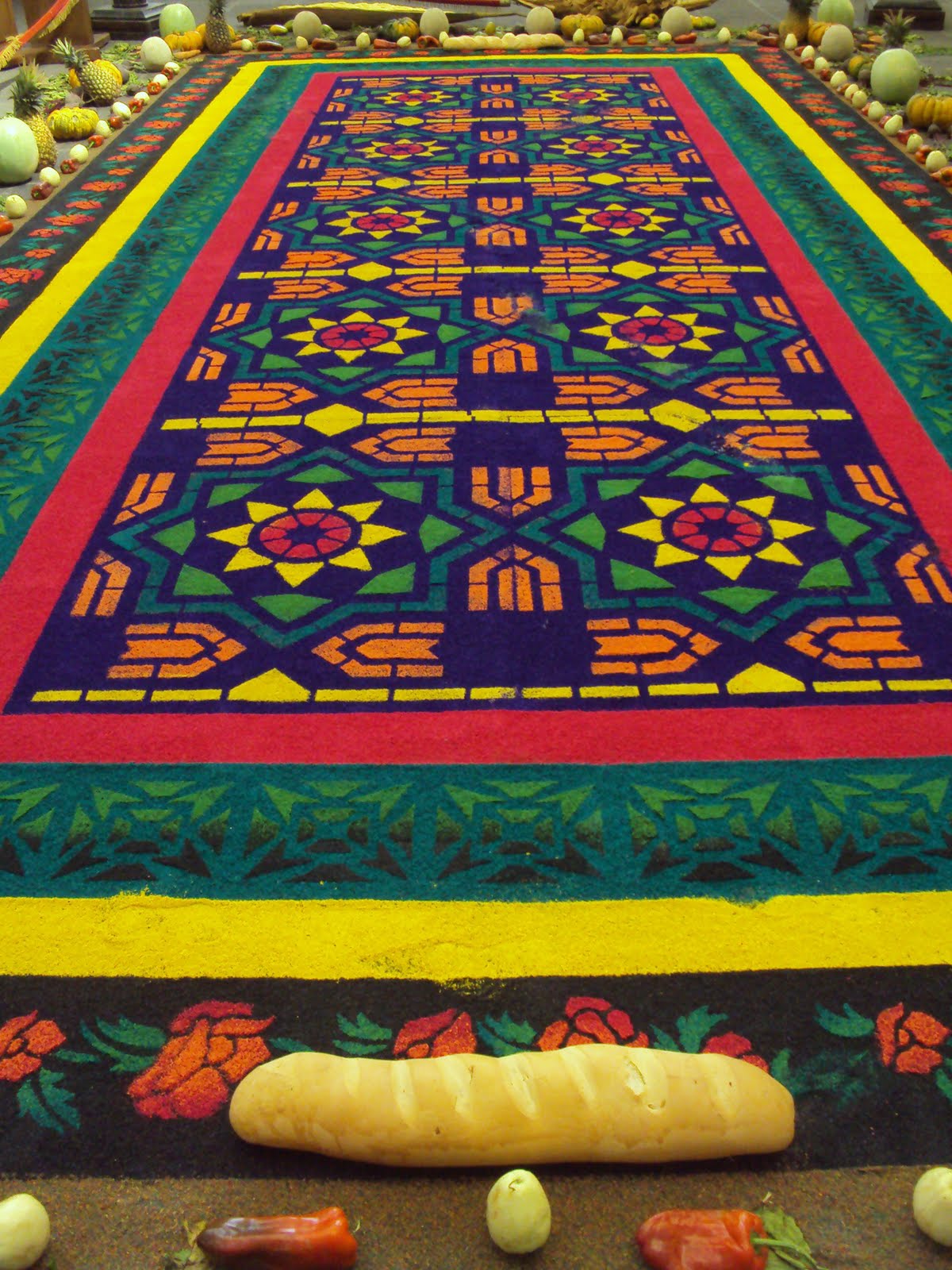
On our walk, we visited a few churches, and because it was Lent, we were able to see some very interesting mixes of the Catholic and Mayan religions. In the churches, there were alfombras (carpets) of colored sands. It looked just like a carpet from far away, but the detail up close was spectacular. The hours spent on putting those together would be exhausting, but the cultural significance is truly amazing. The bright colors are seen all over Guatemala, and it is almost synonymous with their country. Also, there were many, many, many, statues and depictions of saints and Jesus in the churches, but not only that, they were very gruesome when depicting Jesus. There was a lot of fake blood, and the welts on his back from the whips were disgustingly life-like.

The market with vibrant colors.
From there, we moved onto the market to practice our Spanish! I haven't had Spanish in two years, and I'm sad to say that most of what I knew has been lost. I can ask simple things, and I remember my numbers, so I was good to go for the most part. If the bartering became too heated or complicated, I switched to English, and most of the time, they spoke in English recognizing that my accent wasn't quite right or that I am white. My first purchase of the day wasn't the best--it was my first time bartering, but I got better as I went on. A note on the currency: the equivalent of a dollar in the US is the Quetzal (also the name of the national bird). One US Dollar is the same as 7.8 Quetzales. I was swimming in money! I came out of the bank after changing $160 with over 1000 Quetzales. Also, the things there are very cheap--I thought I was spending a lot of money, but I was buying scarves for just four, five, or six dollars. In the end, I spent about $120 dollars on everything (food, souvenirs, water) while I was there.


Me with the Volcán Agua.
After a day of shopping in which I bought most of my souvenirs, we headed to Pollo Campero, the restaurant equivalent of McDonald's (although there are McDonald's there...more on that soon). It was all chicken, hence the name Pollo, and it was pretty good. Very cheap food that was more than filling. I ended up with a breaded chicken sandwich, fries, and a soda for something like six or seven dollars. Another side note: we were warned about some of the food before going. If we wanted to remain un-sick for the duration for the trip, we could not eat food that did not have a peel (tomatoes, lettuce) because they way they wash the foods is different. Also, no water off of a tap (and that meant not getting any in our mouths while showering or brushing our teeth with sink water). This was not a reflection on the Guatemalan water system--it isn't necessarily dirty; we are just used to purified and processed water, whereas their stomachs can handle water that hasn't been through that kind of treatment.

From there, we toured the local McDonald's. I'm not joking, it was like a sit-down restaurant. The McCafe had cheesecakes and a whole separate room! There were gardens and a fountain with outdoor seating. Pretty damn fancy for a McDonald's. We went back to the hotel for a bit, and then some of us explored some more. We went back through the markets and made our way back to the hotel. After a nap on my part, a few of us went to dinner and walked the streets at night. But one of the greatest adventures of the night was the shower! My room didn't have a shower, so we had to use one in another part of the hotel. My roommate was using it at the time, so I asked another person in our group to use theirs. It was a fairly large shower, but the water kept getting hot and cold and it puddled at my feet. And most of our group had broken showers, so the hotel was fixing them at all kinds of the night. Right after that, I passed out in bed.

The next morning we packed up our things, had breakfast, explored a few ruins before leaving for San Jorge La Laguna, the small town we would be working in. I will pick up with the blog at San Jorge soon. But, this was getting long, and I know most people just don't have that kind of attention...oh, look, something shiny! Gotta go!

Wednesday, March 23, 2011

Donating to Mayan Families

Hello blog followers!

I'm back from Guatemala with more than a few bruises and bug bites, but I made it safe and sound. I will update about my adventures this weekend sometime, but first I wanted to post a few videos from an organization called Mayan Families. We met with a woman that works at/runs the organization while in Guatemala. They help a lot of children and elderly in the area. I met this little girl in the Claudia's Story video, and she is just as beautiful in person. We also visited the building they feed the elderly lunch in, and it was a great experience. One last note: if you know anyone that is willing to donate/help raise $10,000 (I know, a lot), the local community center/church area needs a new roof in the town I worked in. The building was built in the 1700s, so it would be great to preserve it. Mayan Families is helping with that, so let me know if you know someone! Here are the videos below.


Saturday, March 12, 2011

One year ago today...

So, I was bored because break just started, and I am waiting for my laundry to be done so I can start packing. I happened to decide to look back on my blog to see what I was doing one year ago today. I think it can be described in one picture:


Yeah, on March 11, 2010, I had my picture taken with Gerard Butler. And, on March 12, 2010, I was probably staring at the picture all day wondering how in the world it happened. Life in Europe rocked.

I suppose I can't complain too much...I am leaving for Guatemala tomorrow night. And my friends rock, school sucks (but that's normal), I have an awesome boyfriend, my family is great, spring break is here, and the weather is looking up. Definitely trying to see the bright side of not being in Europe.

Signing off...be back after working in Guatemala.

Thursday, March 10, 2011

Midterms, tonsillitis, and Guatemala

Happy spring everyone!

Well, almost spring...

I realize that it has been over a month since the last time I updated, but school is just too overwhelming most of the time. I never really feel compelled to write in my blog. Since I am leaving for Guatemala in just two days, I thought I would give a brief life update.

Mostly I have been focusing on school with a lot of reading. I read, write, sleep, eat, lift, play some volleyball, sleep some more...it's not really that exciting. Bad news though, I did get tonsillitis two Thursdays ago. It was terrible for about two or three days. After that, I was just tired most of the day. I got over it slowly, but now I am ready to go!

Midterms were today, and I got about five hours of sleep last night because I got up early to study for my 8 a.m. midterm. I had three papers due today on top of that test. It was not a fun week--sleep deprivation, a lot of stress, and not enough time with my friends. But now it is time for Spring Break.

I haven't packed yet, in fact, I am getting ready to start very soon. I am cleaning my room so it will be nice and tidy when I get back on the 22nd at 3 a.m. Well, I will update about everything when I get back because I will not have a lot of access to a computer when I am down there.

Thursday, December 2, 2010

Alternative Spring Break - Guatemala

Hey all!

So, I'm not entirely sure as to who will be reading this post, but I figured I would give it a go anyway. I am going on another Alternative Spring Break trip next semester. I went on the very first one Central hosted two years ago to Moab, Utah and had a fantastic time. So, I decided to apply to go to Guatemala, and I was accepted into the program.

Alternative Spring Break has been a program at Central for three years now, and is growing each year. This year, a trip was added to San Jorge La Laguna, Guatemala and will be held March14-21, 2011. I will be volunteering with eleven other Central College students in a school. This school has begun an environmental/sustainability program and is working to teach the children the importance of things such as recycling, reusing, and reducing as well as global environmental issues. The school receives no funding from the government, so they are doing what they can with what little they have. We will help support this program by helping to build an ecological classroom out of recycled materials as well as other activities to support the school.

We are looking for donations to help us make this trip a success. If you or anyone you know would be willing to make a donation, have them get in contact with me via this blog in the comments or my email: griegerc1@central[dot]edu (just remove the word 'dot' and put an actual one there. I don't want to be spammed by some computer!).

Also, if a Central student happens to be reading this, we are selling the "Go Dutch" t-shirts still! They are just $10 and all the profits go to help us in Guatemala!

Thanks!
Chelsea :)